OpenAI’s 2026-08-03 engineering post about GPT-Live describes a voice system that can keep listening while it speaks. The headline is full-duplex conversation. The more useful design lesson is underneath: protect the live media loop from slower work.
OpenAI says it separated continuous audio from application logic so tool calls and deeper reasoning could run asynchronously. The system also carries conversation state forward, compacts long histories and reconciles a fast speculative transcript with a later authoritative one.
That architecture is specific to OpenAI. It is not a benchmark for every voice product and the post is not the public API contract. Still, it gives interactive-character teams a sharp question: if voice is continuous, what else in the character stack must remain continuous and what can safely arrive later?
For a voice-driven 3D character, there are not two paths. There are three.
The media path must never wait for a slow idea
The first path owns the live exchange: listening, speaking, interruption and turn timing. Its job is continuity.
If this path blocks on retrieval, a remote tool or a long reasoning step, the user does not experience a thoughtful character. They experience a broken call. OpenAI’s design separates the media path from slower application work for that reason.
The public OpenAI Realtime API reference is the narrower product boundary. It documents realtime multimodal sessions over WebRTC, WebSocket and SIP. The GPT-Live post goes further by describing internal architecture and an announced system. Keeping those two evidence classes separate matters: a useful engineering disclosure should not be mistaken for a promise that every component is already exposed as a public API.
For teams designing a character experience, the media-path review is simple:
Can the character keep listening while it speaks?
Can the user interrupt without waiting for a tool to finish?
Does a slow dependency degrade the answer or stop the conversation?
Which event definitively ends the character’s current turn?
These are not only latency questions. They define who controls the floor.
The application path may be slow, but it must be explicit
The second path owns work that improves the answer but should not freeze the exchange: search, tools, game-state queries, safety checks and deeper reasoning.
Asynchronous does not mean ungoverned. Every delegated job needs an identity, a deadline and a rule for late results. Otherwise a tool can return after the conversation has moved on and make the character answer a question the user no longer cares about.
A practical application-path contract records four things:
What request started the job?
Which conversation state is the result allowed to modify?
When is the result too late to use?
What does the character do while the job is still running?
The last question is an editorial decision as much as a technical one. A character might acknowledge uncertainty, continue with a bounded response or ask for time. What it should not do is silently stall while the system waits.
A visible character creates a third path
Audio can remain responsive while the character still looks wrong.
The visible-performance path owns mouth movement, gesture, gaze, posture, animation transitions and the timing relationship between those signals. It has its own continuity budget because animation cannot always stop at the same instant as audio. A gesture may need a clean exit. A gaze target may change before a sentence ends. An authoritative transcript may arrive after lip sync has already been scheduled.
This makes a voice-driven 3D character a three-path system:
Live media protects listening, speech and interruption.
Application logic runs tools, reasoning and state work without blocking the media loop.
Visible performance schedules and reconciles what the character does on screen.
The paths share events, but they should not share one blocking clock.
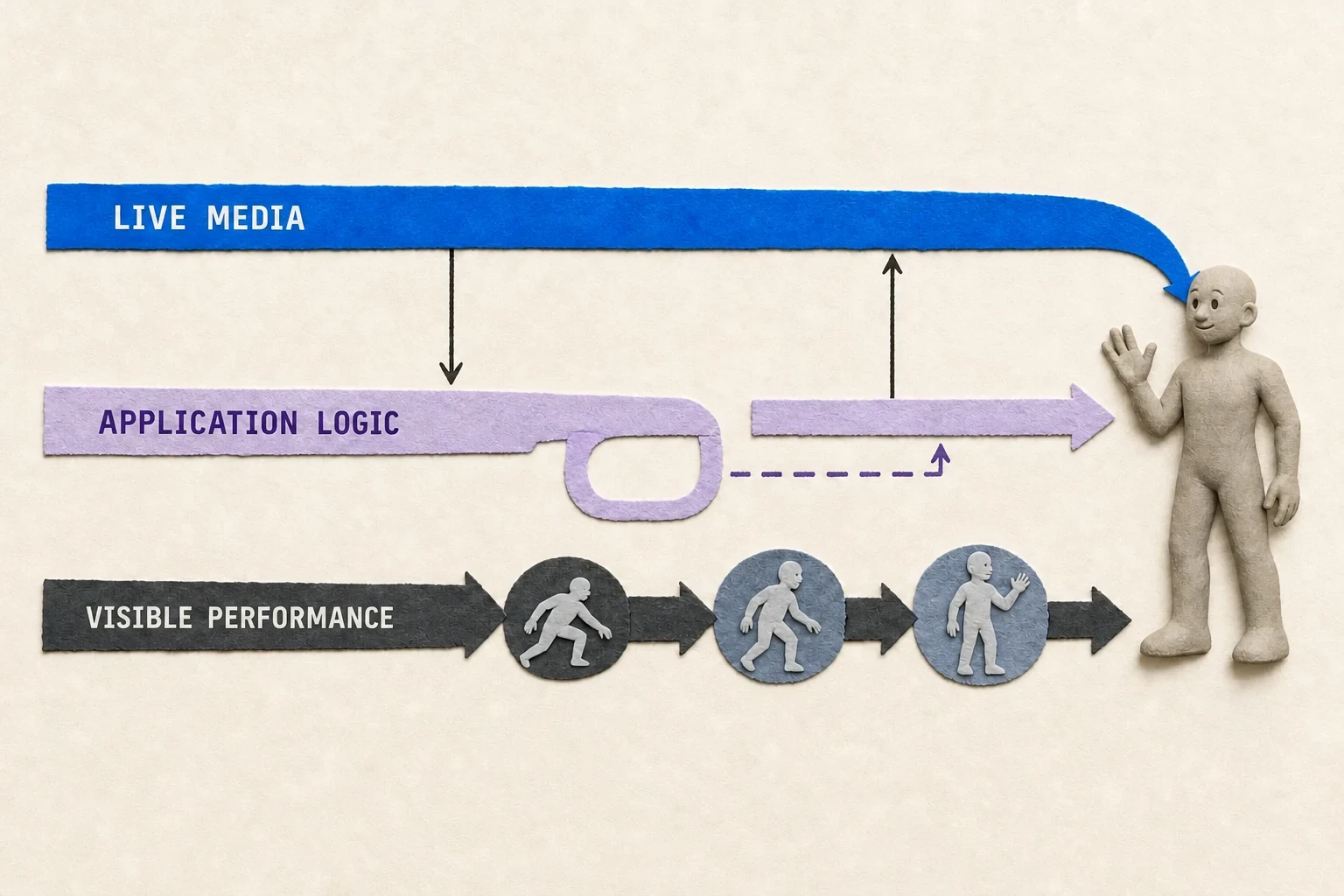
The three paths exchange state, but only the live-media path owns the immediate conversational floor.
Design interruption as a contract, not an edge case
Full-duplex voice changes interruption from an exception into normal input. That forces the three paths to agree on what happens next.
Suppose the character begins a sentence, starts a pointing gesture and launches a tool call. The user interrupts two seconds later. A robust system needs separate answers for each path:
Media: stop or duck speech, preserve the new user input and assign the floor.
Application: cancel the tool job, let it finish without authority or retain it only if the new turn still needs it.
Performance: exit or redirect the gesture without snapping the character into an impossible pose.
Those decisions should be observable. If the logs only show one conversation state, the team cannot tell whether a bad moment came from audio timing, stale tool authority or animation cleanup.
Keep speculative and authoritative state separate
OpenAI describes using both speculative and authoritative transcripts. The fast version helps the system respond. The later version becomes the record that future turns should trust.
The same distinction is useful for character performance. A live system may schedule approximate mouth shapes, a lightweight listening pose or a provisional gesture before the final utterance is known. Those choices keep the character alive. They should not silently become durable truth.
The reconciliation rule can be small:
speculative state may drive reversible presentation
authoritative state owns memory, analytics and future decisions
every correction declares which visible actions should continue, soften or stop
Without that boundary, a fast guess can leak into persistent character state. With it, teams can trade a little precision for responsiveness while keeping the later record trustworthy.
Test the session, not the demo
Short demonstrations hide the failure modes that matter most. OpenAI’s post calls out stateful inference, context compaction, model handoffs, production testing, capacity and geography. Those are reminders that responsiveness has to survive time and load.
A character-team test should therefore include more than first-response latency:
a long session that forces context reduction
repeated interruptions during speech and gesture
a slow tool that completes after the user changes topic
a network interruption during active media
a model or service handoff mid-conversation
a correction where the authoritative transcript differs materially from the speculative one
Measure continuity by path. Audio recovery time, stale-result rejection and animation-exit quality describe different failures. Combining them into one average latency number makes the system harder to improve.
Where Snippets3D fits—and where it does not
Snippets3D is a cloud-assisted character-performance creation and Unity delivery platform. It turns scripts, prompts or audio into reusable performances and gives teams a controllable production layer for character behavior.
It is not a speech-recognition system, an autonomous NPC brain or a realtime conversational AI product. Real-time and hybrid generation are roadmap directions rather than current capability. This article does not announce a GPT-Live integration.
The useful connection is architectural. A team combining open-ended runtime voice with controlled character performance still has to decide which behaviors are generated live, which are authored and reusable and how interruptions cross that boundary. Snippets3D belongs on the performance side of that decision, where repeatability, editing and Unity delivery matter.
Run one three-path review
Take one representative interaction and draw three horizontal lines: media, application and performance. Mark the start of speech, every tool request, each gesture or gaze change, the user’s interruption and the arrival of authoritative state.
Then ask one question at every cross-path dependency: must the live exchange wait?
If the answer is no, make the work asynchronous and define how late results lose authority. If the answer is yes, make the pause visible and intentional. For the performance path, define a reversible state that can bridge the delay without pretending the final response is already known.
Continuous voice raises the standard for character responsiveness. The practical response is not to force every subsystem onto the fastest clock. It is to give each path a clear job, then make their handoffs and corrections explicit.
Sources and evidence boundary
OpenAI, How we built a realtime system for responsive voice AI in six months, published 2026-08-03.
OpenAI, Realtime API reference, accessed 2026-08-19.
The architecture descriptions are first-party source assertions. This article did not independently benchmark GPT-Live, does not imply that every internal component is exposed through the public Realtime API and does not announce a Snippets3D integration.
Written by Cristian Anton
