Research
7 MIN READ
Can Video Models Remove the Character-Specific Data Bottleneck in 3D Speech Animation?
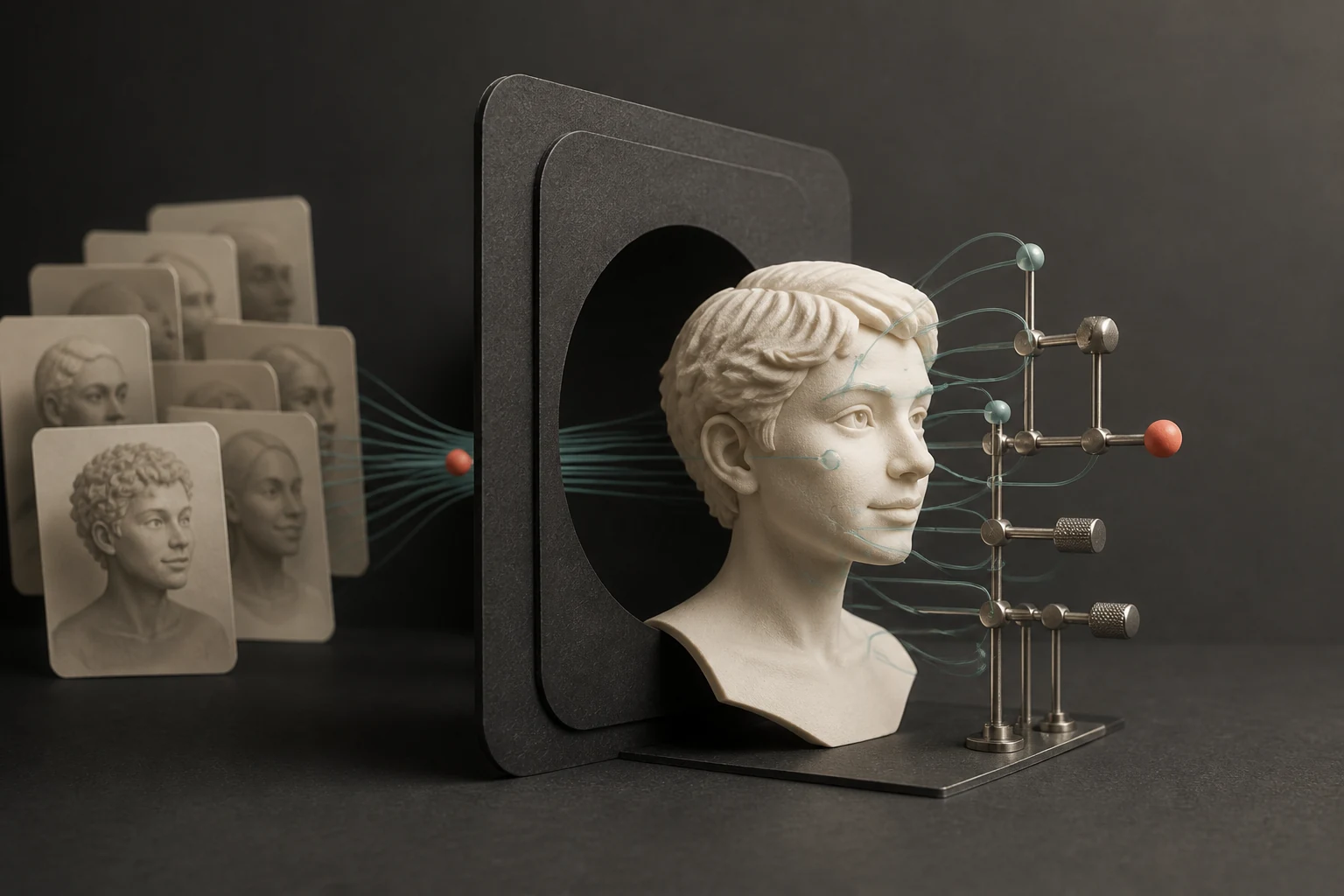
Speech animation usually becomes character-specific sooner than teams expect. A model may accept audio generically, but the production path still depends on a facial rig, compatible targets, retargeting decisions and enough character-specific examples to make the output plausible.
AnyTalk, submitted on 2026-08-17 and accepted to TVCG, proposes a different route. The authors say it can generate 3D speech animation for arbitrary characters without character-specific animation data. It adapts a pretrained video diffusion model using rendered still images of the target, generates a talking-head video and then estimates 3D blendshape parameters. A distilled variant is designed for real-time use.
That is a meaningful research direction. It does not make adaptation disappear. It changes what adaptation consists of.
The bottleneck is larger than training data
Character-specific animation data is expensive because it combines several jobs: capturing or authoring examples, aligning them to a facial representation, training or fitting a model and validating the result on the target rig.
AnyTalk attacks the first part directly. Its character-specific fine-tuning uses rendered images paired with a no-motion audio condition, relying on the motion prior in a large video model rather than animation examples from the character.
If that holds across a production roster, a team could trade a dedicated animation dataset for a controlled rendering set. That is attractive for stylized characters, legacy assets or large casts where collecting performance data per face is unrealistic.
But the new path still needs a renderable character, a usable facial parameterization and a reliable way to lift the generated video back into 3D controls. The right question is therefore not “does it need data?” It is “which character-specific assets and decisions remain?”
Run a five-gate character-adaptation test
Evaluate a method like AnyTalk through five gates:
Render gate: How many views, expressions and lighting conditions must be rendered for one character?
Representation gate: Which blendshape sets and facial topologies can the optimizer recover reliably?
Identity gate: Does the generated motion preserve the character's proportions and style under speech?
Control gate: Can an animator inspect and revise the recovered 3D parameters rather than accept only a video result?
Runtime gate: What quality, latency and hardware trade-offs remain in the distilled model?

Video priors can broaden motion knowledge
The central idea behind AnyTalk is that a large video model has already learned useful patterns of facial motion from extensive video data. Fine-tuning the model to the target character's appearance can preserve that motion prior without requiring animated examples of the target.
This is important because 3D datasets rarely match the breadth of real video. Video priors may carry variation in articulation, expression and timing that would be expensive to capture for every rig.
The risk is that visual plausibility and rig plausibility are not identical. A generated frame can look convincing while the recovered blendshape sequence is noisy, physically awkward or hard to edit. Production teams should inspect the 3D curves, not only the rendered output.
Arbitrary characters need adversarial evaluation
“Arbitrary” is a demanding word. Test it with the characters most likely to violate the method's assumptions:
non-human proportions and unusual mouths
sparse or nonstandard blendshape sets
facial hair, masks or occlusion
highly stylized materials and silhouettes
extreme head turns or expressive speech
The aim is not to disprove the paper with one edge case. It is to map the operating envelope. A method that works across several common rig families but not every creature can still be valuable—if the boundary is explicit.
Measure roster cost, not one-character setup
The real opportunity appears at roster scale. Compare two workflows across ten or twenty characters:
hours of target-specific preparation
GPU time and iteration count
percentage of lines accepted without curve cleanup
failure patterns by rig family
time to reproduce a result after the character changes
This reveals whether the approach removes a bottleneck or moves it. A setup that is impressive on one face may still become expensive when every character needs unique rendering, optimization settings and manual acceptance criteria.
Where a controllable production layer still matters
AnyTalk focuses on speech-driven facial animation. A complete 3D character performance also has to coordinate voice, timing, body movement, gaze, text and events, then deliver reusable behavior into a runtime.
Snippets3D currently provides a controllable production layer for creating and delivering synchronized 3D character performances in Unity. This article does not announce an AnyTalk integration. The relevant connection is workflow: if research reduces the cost of adapting facial motion to new characters, production tools still need to make the resulting behavior reviewable, editable and coherent with the rest of the performance.
That is the production test worth running. Do not ask only whether the method can make a character talk. Ask whether it can reduce adaptation cost across a roster while leaving behind controls your team can own.
Sources and evidence boundary
Kwan Yun et al., AnyTalk: Speech Animation for Arbitrary Characters Leveraging a Video Generation Model, arXiv:2608.16143v1, submitted 2026-08-17.
AnyTalk project page, accessed 2026-08-20.
The reported results and real-time claims are author assertions from a v1 research paper and project page. They were not independently reproduced for this article.
Written by Cristian Anton
