
A generative animation tool becomes useful in production when artists can still direct the result. That means setting constraints, changing timing, revising only the weak section, editing existing motion and handing the performance to a familiar finishing workflow. A convincing first clip is not enough.
Disney Research's recent Generative Motion Rig is interesting for exactly this reason. The prototype puts a generative model behind rig-like controls in Blender. Instead of asking an artist to accept or reject one complete output, it lets them shape motion through poses, spatial handles, timing edits, local resampling, extension and layers.
The research does not prove that this system is ready for a production deployment. Its user tests were exploratory and its authors describe important limitations. But it offers a much better question for evaluating the next wave of AI animation tools:
Does the system behave like an editable rig, or like a slot machine that produces another clip each time you pull the lever?
What Disney Research actually built
The paper, A Generative Motion Rig for Artist-Driven Motion Authoring, describes a Blender plugin connected to a GPU-backed generative system. Artists can provide sparse joint constraints or complete keyframes. The system turns these controls into what the authors call Neural Motion Curves, then generates the motion between them.
The interface is designed around several familiar animation jobs:
Generate full-body motion from a small number of poses and spatial constraints.
Adjust when an action happens without rebuilding the entire performance.
Resample a selected time window while preserving motion outside it.
Extend motion before or after an existing sequence.
Edit motion-capture or other existing animation.
Blend generated motion with traditional inverse-kinematics and forward-kinematics layers.
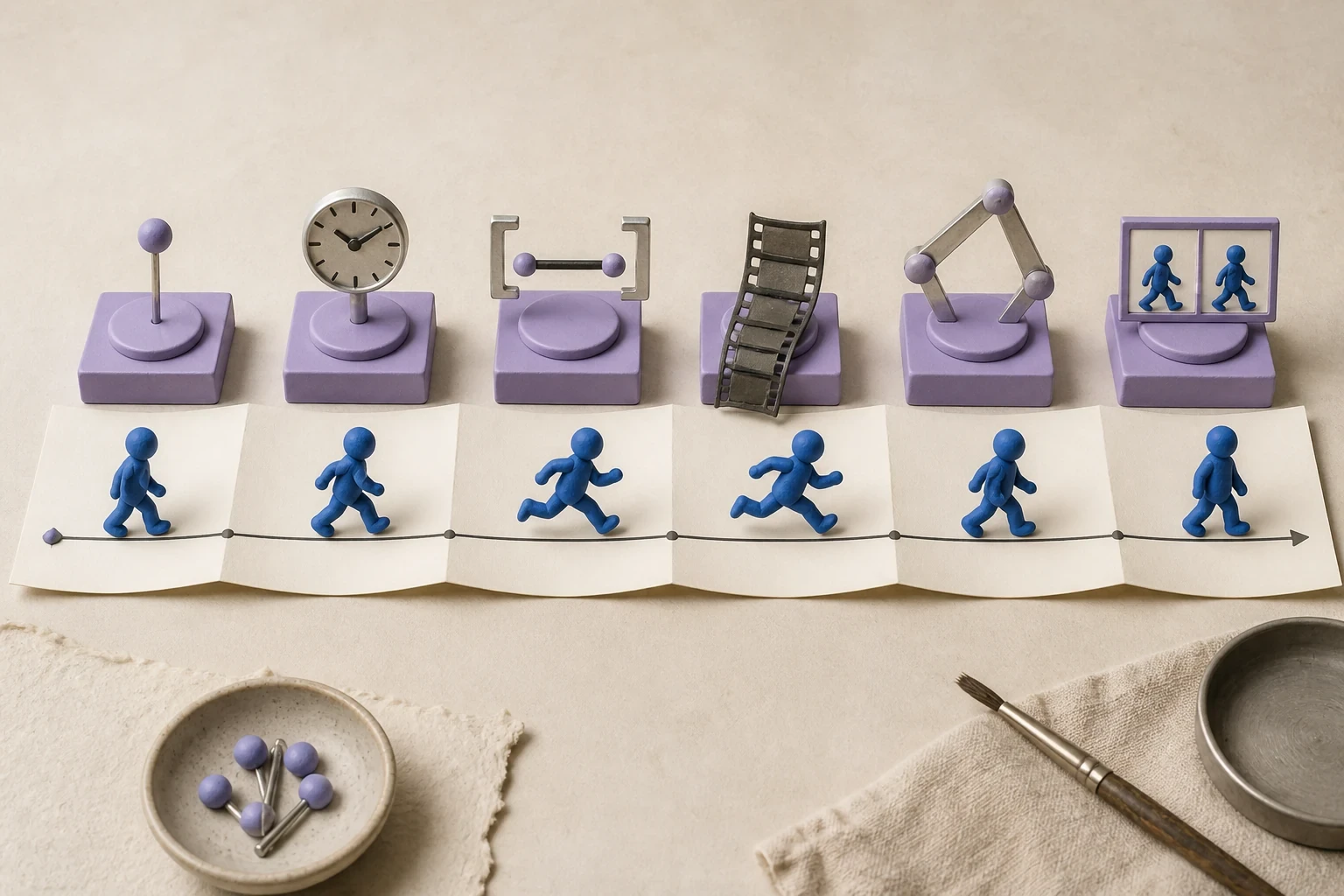
The editability test follows the decisions an artist must preserve from constraint through revision and handoff.
Those capabilities matter because they expose decisions an artist can revisit. The generated motion is not treated as a sealed video clip. It sits inside an authoring process.
The implementation is still a research prototype. It uses Disney Research models for motion posing and in-betweening, though the authors frame the rig as an interface that could sit over other compatible motion engines. The useful idea is therefore larger than one model: generation becomes a production tool when an artist can constrain its uncertainty.
Why a rig is different from a generator
A generator answers, "What motion could go here?" A rig must also answer, "Which parts can I change without losing what already works?"
That difference appears after the first review. A director may like the path of a character's hand but ask for the step to land earlier. A technical animator may need the entrance preserved while replacing only the turn. A finishing artist may need to layer a precise contact pose over otherwise usable generated motion.
If every request requires a fresh clip, the model owns the revision. If the artist can isolate time, preserve approved regions and combine generated motion with deterministic controls, the artist owns it.
This is the animation-specific version of a broader principle we explored in Why Directable 3D Control Matters More Than Better Prompting. Prompting expands the search space. Production controls make a chosen result repeatable, reviewable and finishable.

The six-part generative motion editability test
When evaluating a generative animation tool, use a representative shot and test these six capabilities. Do not stop after the first plausible output.
1. Can the artist state the non-negotiable constraints?
Choose the decisions that must survive generation: a planted foot, a hand contact, a starting pose, an ending pose or a prop interaction. Check whether the artist can express those constraints directly and whether the result respects them across repeated generations.
Natural-language intent is helpful, but it is not a substitute for spatial or pose-level control when exact contact matters.
2. Can timing change without redefining the action?
Move one beat earlier or later. Stretch a pause. Shorten the anticipation before a jump. The tool should let the artist adjust the timing of an approved action without having to rediscover its content.
This is where a motion curve is more useful than a list of generated clips: timing becomes an editable dimension rather than an accidental property of the sample.
3. Can a weak region be resampled locally?
Mark the smallest unsatisfactory interval and regenerate only that section. Then check the boundaries. Does the replacement preserve the surrounding performance, or does it introduce a visible discontinuity and force a larger repair?
Local resampling is valuable only when "local" is predictable. A small selection that changes approved motion elsewhere is not a dependable production control.
4. Can the tool work with motion the team already owns?
Import a piece of motion capture or a keyed animation, then edit or extend it. Production rarely starts from an empty timeline. A useful system must fit around existing takes, libraries, retargeting decisions and work already completed by other artists.
This is one reason the Disney prototype's editing and extension workflows are notable. They shift the conversation from pure generation to integration.
5. Can generated and traditional controls share the same shot?
Test the handoff to the team's finishing tools. Can an animator layer inverse kinematics or forward kinematics over generated motion? Can they switch methods where precision is required? Can the result remain editable after the generative stage?
A generative layer should reduce work where uncertainty is useful. It should not block deterministic control where the shot demands it.

A rigging workspace makes the handoff requirement concrete: generated motion still has to meet the tools used for editing and finishing. Image by Blender Foundation, licensed under CC BY-SA 3.0 via Wikimedia Commons.
6. Is the effect of a revision predictable enough to review?
Add one new constraint after the shot is mostly approved. Repeat the operation. Ask what remains stable, what changes and whether the reviewer can understand the boundary.
This final test is the most important. Production is a sequence of revisions. If the same small request can create unrelated changes each time, the team inherits a new review burden even when generation itself is fast.
What the paper does not establish
The authors report promising exploratory use, but the evidence is deliberately small.
In one freestyle test, a professional artist created a 22-second chase animation in under two days, including time spent learning the system and storyboarding. The artist appreciated the speed of creating complete motion but found polishing and finalizing difficult. The sampling process and the effect of the selected time window were unfamiliar.
In a second guided test, one professional artist and one non-artist who was also an author each had 90 minutes to make a 45-second parkour animation. Both completed the task using different workflows. That shows that the interface supported more than one working style in a tightly bounded exercise. It does not establish broad usability, production speed or output quality across teams.
The paper also identifies technical limits. Results remain bounded by the training data, especially for stylized or non-physical motion. Blending generated sequences without physical or stylistic inconsistencies remains unresolved. Adding new constraints can make the result unstable. Complex rigs and different character morphologies remain open challenges. One synchronization mode can produce a visible pop when a previously generated pose becomes a new condition.
These are not footnotes to hide. They describe the exact places where a convincing demo can become expensive production work.
What this means for character-production teams
The lesson is not that every team needs Disney's prototype. It is that tool evaluation should move one step downstream from generation.
Text-to-motion benchmarks can tell you something about model capability and efficiency. They cannot tell you how an art director will revise a shoulder line, how an animator will protect a contact pose or how a technical team will finish and deliver the motion.
At Snippets, the same principle appears in a different part of the stack. Snippets is a controllable production layer for creating and delivering synchronized 3D character performances in Unity. Creation, preview, refinement, publishing and Unity delivery remain distinct decisions. Snippets does not provide the Generative Motion Rig described in the paper, but the workflow reinforces the underlying judgment: generated material earns its place when the team can inspect and refine it before delivery.
More controls are not automatically better. A dense interface can simply move complexity from the model into the artist's hands. The goal is to expose the few decisions that materially affect the performance, keep variation bounded and make the consequences of a change legible.
Run one revision before you buy
Choose one representative motion, get it to a plausible first result and then ask for a difficult but normal revision. Change a contact, retime one beat, preserve the approved opening and hand the result to the person responsible for finishing it.
Measure the whole loop: instruction, generation, review, repair, export and handoff. Record what remained stable and what had to be rebuilt.
That test will tell you more than a highlight reel. The production value of generative animation is not the number of clips it can produce. It is the amount of creative intent the team can preserve while changing one important decision.
For a broader evaluation framework, see How to Choose Character Animation Tools for a Unity Project.
Sources
Written by Cristian Anton

